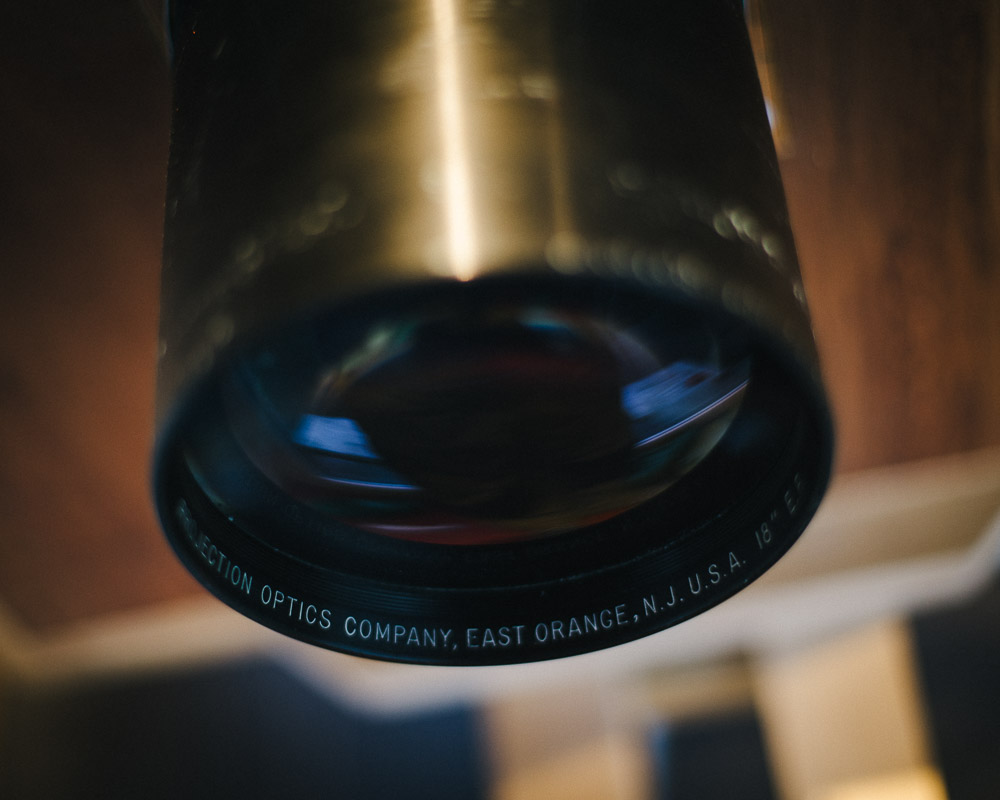
I saw lenses similar to this pop up a few times on wet plate sites and groups, usually surrounded by little concrete evidence on the usability for wet plate, sharpness, coverage… so this "Review" hopefully helps some people who are considering getting one themselves or wondering what they just bought. Note that there exists a similar (I suspect it's rebranded) lens under the name "Charles Beseler 18″ E.F." I've also seen other focal lengths of similar lenses (12″ and 20″).
I got this lens quite cheap (30 Euros including shipping) and it still came with bits of the original device attached to it. I got it with little expectations, hoping it would maybe cover 8″×10″ and be good (and fast enough) for portrait use. These lenses usually go in episcopes if you want some keyword to search for.
Similar lenses minus device seem to be on offer regularly in the 60–250 dollar range (with one outlier claiming 700 dollars).
Tech Specs
This lens is an 18″ (457 mm) lens. The aperture is not mentioned but after measuring the entrance pupil the math works out to f/3.6. The aperture is fixed at f/3.6 — there is no diaphragm or slot for Waterhouse stops. I did some preliminary tests and it seems a cardboard aperture is effective at stopping the lens down (see below). It's quite big and heavy (~2.5 kg) so take this into account for any camera you are trying to mount it on.
Optics
These projection lenses are often Cooke triplets. This is a more recent (as recent as 1893) three-element design than the Petzval lens (est. 1840) loved by collodionists. It is so "advanced" it corrects the swirly bokeh "artifact" of Petzvals. But bokeh lovers don't despair — a 457mm f/3.6 lens is still a bokeh fest. Depth of field is usually millimeters. And even at focus distances of 10–15m it still isolates anything you focus on.
Sharpness & Contrast
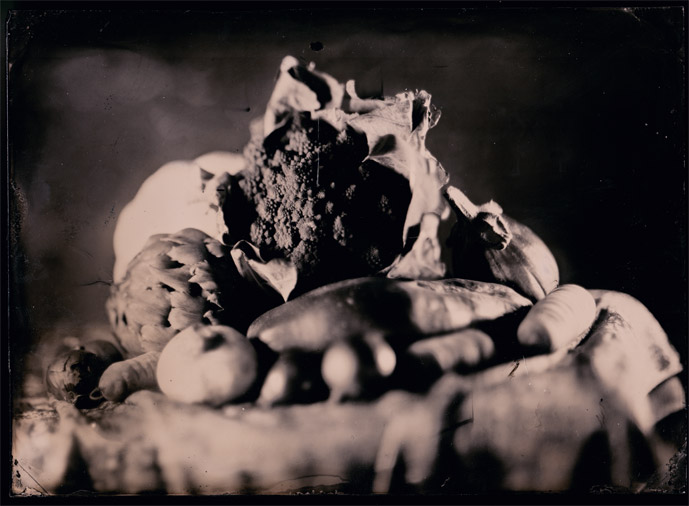
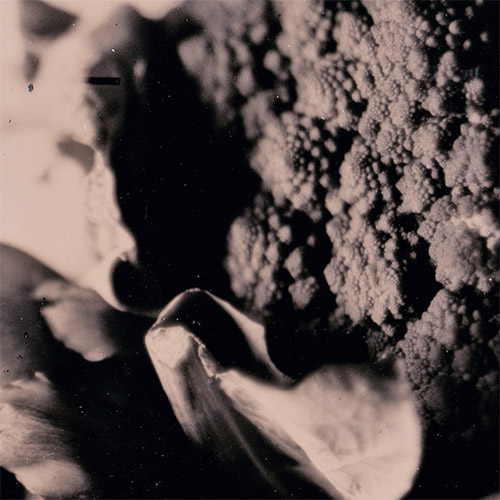
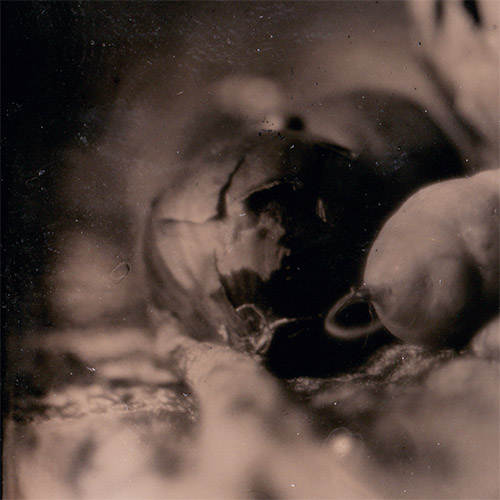
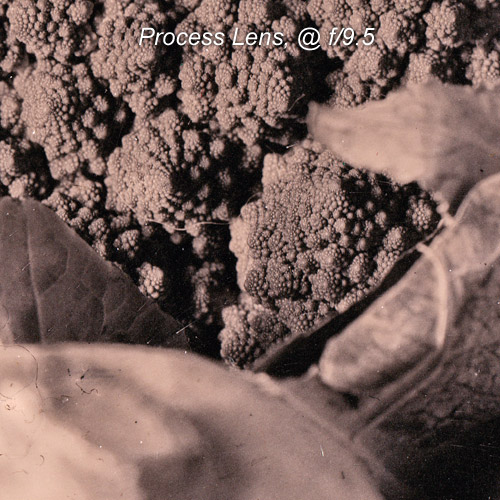
One of the biggest worries people have when using projection lenses is low sharpness, and this lens is certainly not outstanding in this respect. However, it is quite a bit better than I expected. It certainly has the resolving power for ambrotypes and contact prints (and probably more than enough for alternative processes on rough paper). I wouldn't use it in an enlarger though.
Contrast (a.k.a. micro contrast) of this lens is quite low. I find this lens has a certain soft-focus feel to it. I wouldn't call it bad for subjects such as portraits but if you want very crispy details (rocks, tree barks…) I think you wouldn't be happy with it.
Also note that f/3.6 gives really narrow DoF — it's almost too wide. At shoulder portrait ranges for 18 × 13cm plates f/3.6 still barely keeps the eyes in focus. Nose and forehead will already be out of focus.
Coverage
Focused at infinity it falls just short of covering 35 × 42cm — the image circle seems about 50cm at infinity. At a portrait focus distance of about one meter it covers the full 35 × 42cm area I can measure. While good in the center, sharpness does fall off towards the edges, though it is much sharper than the older Petzval design in the corners.
Practical Aspects & DIY
These lenses are meant for use in projectors so using them on a camera requires some creativity. A lot of these lenses have smooth tube barrels so you'll have to do a bit of DIY to mount them. The black rubber you see in the pictures is an old bicycle inner tire — it serves as protection for the barrel, anti-slip on the L-brackets and makes the small gap between the lens board and barrel light tight.
You will also need to come up with a lens cap shutter. I use a bookbinding canvas approach similar to commercial lens caps.
Finally, you will probably need some form of aperture control as f/3.6 is really wide for practical use. Placing the aperture immediately at the front or at the back of the lens seems to work fine and doesn't seem to cause significant vignette or loss of coverage. I will probably stick with putting them at the back so the aperture is inside the camera — it's easy to change by taping a new piece of cardboard in place when the back is open.
One thing to note if you stop down a lens in this way: it reduces the coverage area. Stopping it down to ~f/16 focusing at infinity reduced coverage to about 23 × 17cm in my case — just too low for 8″×10″. Again, focusing at portrait distance greatly improves coverage.
Conclusion
If you want a fast entry-level wet plate portrait lens which supports large formats this lens can do that. Step it down a bit and you'll get ok DoF and quality with shortish exposure times.
On the other hand, if you want to do landscapes or dead tree trunks it's probably not a good idea as you can get much better micro contrast (but with a lower maximum aperture) glass for the same money (search term "process lens").
I'm quite happy with it considering what I paid, although the upper range of the eBay prices seem excessive. I can't stop my feeling that this is like the nifty fifty of wet plate lenses. It's cheap, fast, a bokeh fest, and in the end still gives ok pictures. Just as the fifty it's certainly not the sharpest or most contrasty lens and it hasn't got the nicest bokeh (no Petzval swirlies). Funnily enough, it even costs about the same as a used 50mm — if you find a good deal.
Downsides are the DIY required and the lack of built-in aperture control.